Axe Throwing Business Guide: Costs, Profits, and How to Succeed

The first time you saw a friend post about axe throwing on social media, it probably seemed like just another passing trend. But over the past few years, the activity has become a mainstay of the entertainment scene, proving it’s here to stay. Anyone who has stepped into an axe-throwing venue knows the appeal: There is something undeniably satisfying about sending a sharp object flying and watching it hit exactly where you aimed.
For entrepreneurs watching this trend unfold, the question isn't whether axe throwing is popular anymore. It's whether it's actually a smart business to start. The answer depends on how well you understand the numbers, the risks, and what it really takes to keep people coming back week after week.
This guide breaks down everything you need to know about how to start an axe throwing business, from startup costs and profit potential to safety requirements and marketing strategies. Whether you're scouting your first venue or adding axe throwing to an existing entertainment business, you'll get a realistic picture of what works, what doesn't, and how to build something sustainable.
Why start an axe throwing business?
The appeal of axe throwing is simple. It’s physical without being exhausting, competitive without being intimidating, and just risky enough to feel exciting. That mix draws a wide audience, from competitive league players to first-timers celebrating a bachelor party.
From a business perspective, the magic is in the group dynamic. Unlike activities where people show up alone or in pairs, axe throwing thrives on groups of six, eight, or twelve booking lanes together. Those bookings drive higher average transactions and often fill slots during off-peak hours. Corporate teams come for weekday team-building, birthday parties take over Saturday mornings, and league nights keep weekday evenings buzzing with regulars.
The potential for repeat customers is strong. Axe throwing isn’t usually a one-and-done experience. Once someone gets comfortable, they want to return and improve. Leagues make that easy, creating communities of regulars who not only pay for their own sessions but bring friends who eventually join.
Then there's the social media factor. People love posting videos of themselves throwing axes. It looks dramatic, it's shareable, and every time someone posts a clip, it's free marketing for your venue. That organic reach is hard to replicate with traditional advertising.
Axe throwing business costs
Before you invest in an axe throwing venue, it’s important to understand the costs involved.
|
Cost component |
Estimated initial cost range |
|
Total startup investment |
$100,000 to $250,000+ |
|
Venue build-out & renovation |
$25,000 to $150,000 |
|
Safety equipment & lanes |
$7,500 per lane |
|
Initial inventory & supplies |
$5,000 to $15,000 |
|
Insurance & permits |
$10,000 to $40,000 (initial & annual) |
|
Staffing (initial payroll & training) |
$40,000 to $100,000+ (initial) |
Sources:
- https://businessplan-templates.com/blogs/startup-costs/axe-throwing
- https://startupfinancialprojection.com/blogs/opening/axe-throwing
- https://finmodelslab.com/blogs/startup-costs/axe-throwing
- https://www.xola.com/articles/axe-throwing-business-statistics/
Axe throwing business revenue potential and profitability
Axe throwing can be a profitable venture when operators focus on pricing, group bookings, and additional revenue streams. Here is a closer look at the main revenue drivers:
Average ticket prices
Most venues charge between $25 and $45 per person for a standard throwing session. Some offer tiered pricing depending on session length, private lanes, or access to league nights. Premium sessions such as guided coaching, timed challenges, or private events can command higher prices. Understanding your local market is essential. Setting prices too high can deter casual visitors, while setting them too low may limit revenue potential.
Group bookings and parties
Group bookings are a major revenue driver. Birthday parties, bachelor or bachelorette celebrations, and corporate team-building events often book multiple lanes at once, filling off-peak hours and creating predictable cash flow.
Many venues offer packages that include lane rental, coaching, and sometimes food or drinks. A typical party might range from six to twelve people, but larger corporate groups can double or triple that number, providing a significant boost to daily revenue.
Add-on revenue
Food, drinks, and merchandise can meaningfully increase profitability. Selling snacks, appetizers, craft beers, or themed cocktails encourages guests to stay longer and spend more. Merchandise such as branded shirts, hats, or novelty axes offers a chance to extend the guest experience and generate extra revenue. Some venues also run loyalty programs or membership perks that encourage repeat visits, which can be tied to discounts on food, drinks, or merchandise.
Read more: How to Maximize Revenue with Smart Upselling
Safety, liability, and insurance for an axe throwing business
Running an axe throwing venue means taking on the inherent risk of sharp objects flying in a confined space. That reality makes safety a top priority and solid insurance non-negotiable.
Mandatory safety training
Every guest needs a safety briefing before they pick up an axe. Staff should guide them through proper throwing technique, explain the rules about staying behind the fault line, and make it clear that only the person throwing should be near the target. Most venues have guests sign waivers, but waivers alone will not protect you if someone is injured due to negligence.
Staff training is just as important. Coaches need to spot unsafe behavior and step in immediately. They should be actively watching the lanes, not lingering at the front desk. If someone starts messing around or pulls out their phone in the throwing area, staff must intervene.
Insurance requirements
Insurance for axe throwing businesses tends to be more expensive than for lower-risk activities, but it is worth the cost. Look for a provider familiar with entertainment venues who understands axe throwing. Your policy should cover bodily injury, property damage, and, if possible, assault and battery. Make sure axe throwing is specifically listed and that there are no exclusions that could leave you exposed. A knowledgeable broker can help you get the coverage you actually need without paying for extras you do not.
Best practices for risk management
Lane design is a big part of safety. Proper spacing prevents axes from crossing into other lanes. Backstops must be deep and sturdy enough to stop axes safely. Some venues use stacked wood sections that can be replaced when worn, while others use rubber backstops made for axe throwing.
Other important practices include posting clear safety rules around the venue, setting age or ability limits, and having staff-to-guest ratios that allow lanes to be monitored consistently. Make sure axes and lane materials are inspected regularly, and have first aid kits and emergency protocols ready. Only allow one person per lane at a time and limit distractions like phones or loose objects. Managing crowd size through pre-booked sessions also helps keep the space safe and organized.
With careful attention to training, insurance, and these best practices, you can create an axe throwing venue that is thrilling and safe for everyone.
Marketing and growth strategies for an axe throwing business
Getting people through the door starts with local visibility and word of mouth. Axe throwing isn’t something most people think about on their own, so your marketing needs to plant the idea when they’re planning social activities.
Local SEO and Google Business profile
Make sure your Google Business Profile is fully optimized. Keep your hours, location, and contact info accurate. Upload high-quality photos of your venue, including action shots of people throwing axes. Encourage happy customers to leave reviews, since positive ratings directly impact how often Google shows your business in local searches.
Read more: How to Attract More Guests to Your Venue with Google Reviews
Social media and viral content
Social media is a powerful tool. Share videos of throwing highlights, celebrate league winners, and showcase the fun atmosphere. User-generated content works even better than your own posts. When guests tag your venue or post videos of themselves throwing, share it. This creates social proof and gives potential customers a real sense of the experience.
Partnerships
Local partnerships can bring groups through your door. Connect with corporate event planners for team-building activities, reach out to colleges about student group packages, and talk to wedding planners about bachelor or bachelorette party options. Each partnership acts as a referral channel, expanding your reach without extra ad spend.
Memberships and loyalty programs
Keep customers coming back with loyalty programs or memberships. Offer a punch card where the tenth visit is free, or create a membership tier with discounted rates and priority booking. This generates recurring revenue, smooths out cash flow, and builds a community of regulars around your venue.
Read more: 10 Membership Benefits Ideas To Attract and Retain More Members
Day-to-day axe throwing business operations
Running an axe throwing venue successfully means more than opening the doors. It’s about managing bookings smoothly, keeping equipment in top condition, and delivering an experience that keeps guests coming back.
Staffing and training coaches
The right staffing ratios are essential. One person cannot safely manage multiple lanes while also handling check-in and answering questions. Plan for at least two staff members during open hours, with extra support during peak times. Coaches should focus entirely on safety and the guest experience. Ongoing training ensures your team can guide beginners, correct unsafe behavior confidently, and handle unexpected situations without disrupting the flow of the venue.
Scheduling and capacity planning
Booking can get complicated fast. Private lane reservations, walk-ins, and league members all compete for space. Without careful scheduling, double bookings and frustrated customers are inevitable. Capacity planning software can help you track peak times, lane availability, and recurring events to make sure every session runs smoothly.
Booking systems and venue management software
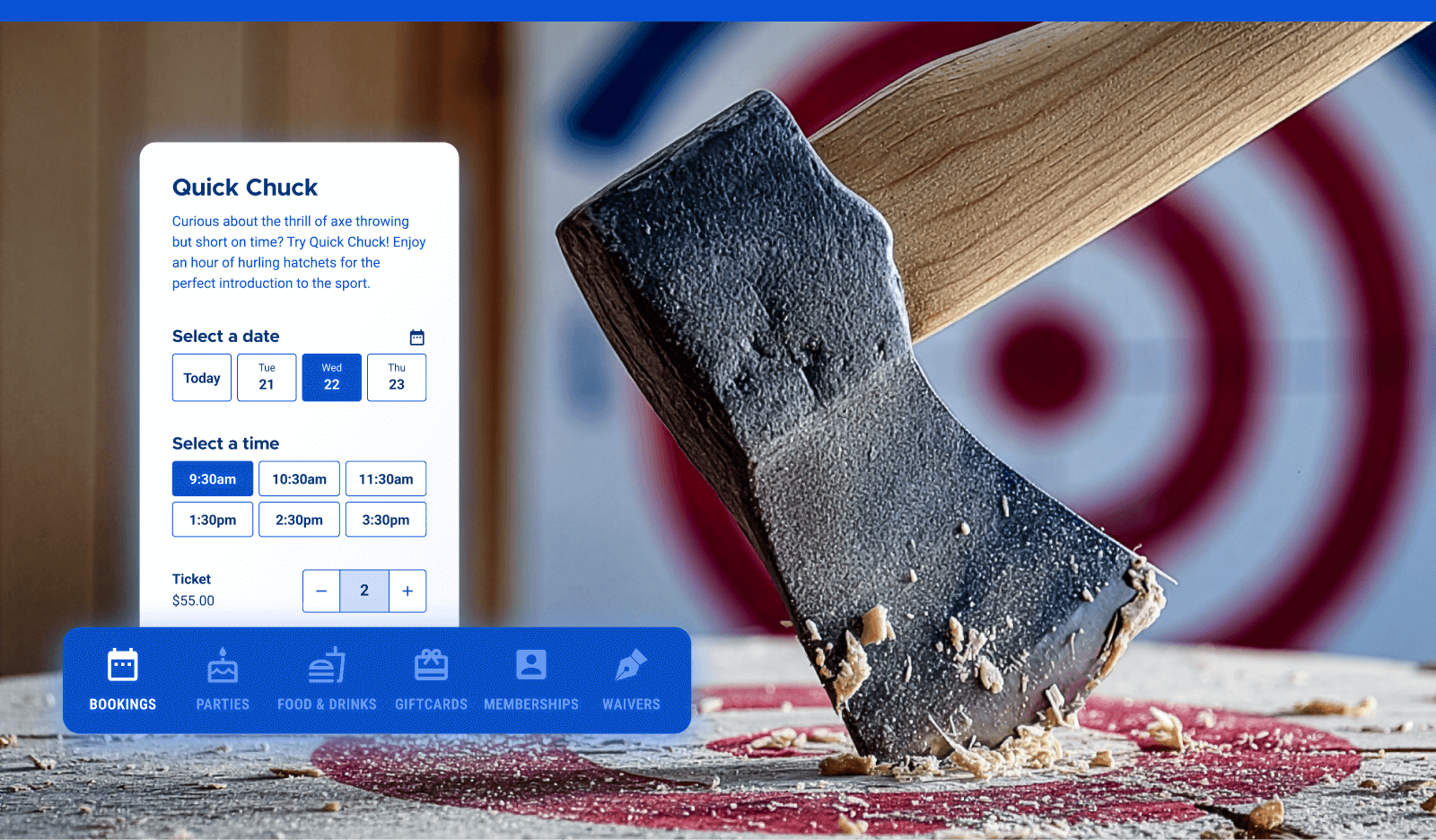
A robust booking system streamlines reservations, allows guests to sign waivers digitally, and helps track lane usage and customer data. Giving guests the ability to book anytime increases revenue and reduces pressure on staff, while providing insights to inform marketing and promotions.
Customer experience
Delivering an exceptional axe throwing guest experience extends beyond the throwing lanes. A welcoming environment from the moment guests walk in is key. Clear signage, friendly staff, and a comfortable waiting area all shape how guests feel and whether they return or recommend your venue to friends.
Equipment maintenance
Consistent maintenance is critical. Sharp axes are essential to a satisfying throwing experience, while dull ones frustrate guests. Sharpen axes weekly or more often during busy periods. Keep replacement handles on hand and inspect targets daily, replacing any that no longer hold axes reliably.
Common mistakes to avoid when opening an axe throwing business
Opening an axe throwing venue can be exciting, but there are a few common mistakes that can slow you down before you even get started.
Underestimating the importance of insurance and safety
One of the biggest mistakes is cutting corners on safety or insurance. Skipping proper protective gear, lane design, or coverage might seem like a way to save money until an accident happens. Invest in proper safety infrastructure from day one and make sure your insurance fully covers your operations. Preventing problems is always cheaper than fixing them later.
Choosing the wrong location
Even a well-run venue can struggle if it is in the wrong location. A hidden spot with poor parking or little foot traffic will not attract walk-ins or casual groups. Look for visibility, easy access, and ideally a location near other entertainment options that help draw people in.
Poor marketing execution
A great venue does not fill itself. Waiting for customers to find you rarely works. Consistent marketing is essential. Focus on building awareness, encouraging online bookings, and giving people a reason to choose your venue over other entertainment options.
Not tracking your numbers
Understanding your costs and revenue is crucial. Keep an eye on your cost per booking, average transaction value, and operating margins from the start. Tracking the numbers helps you spot problems early and make adjustments before they affect your cash flow.
Avoiding these mistakes gives your axe throwing venue a much stronger chance to succeed and grow.
Read more: 5 Ways Smart Data Collection Can Save Attraction Venues Time and Money
Next steps
Running an axe throwing business can be financially rewarding, but it requires careful planning, robust safety practices, and efficient operations. The venues that thrive are the ones that combine a solid foundation with an engaging customer experience.
ROLLER's axe throwing software can help by centralizing bookings, waivers, analytics and more, streamlining day-to-day operations. Schedule a demo to see ROLLER in action.
Disclaimer: This article is not intended as legal advice. Venues should coordinate with the appropriate bodies for specific information about regulations and guidelines.
Frequently asked questions about axe throwing businesses
How profitable is an axe throwing business?
An axe throwing business can be very profitable, especially when it leans into group bookings, parties, and corporate events. Many venues report strong profit margins thanks to predictable session formats and high demand for social activities. Exact earnings depend on location and operating expenses, but it’s common for successful venues to bring in six-figure revenue each year.
What are the startup costs for an axe throwing business?
Startup costs for axe throwing businesses usually fall between $100,000 and $250,000. The final number depends on the size of the space, the level of build-out required, lane construction, safety upgrades, equipment, staffing, and insurance. Operators in high-rent areas or with more elaborate designs may spend more.
Do axe throwing businesses need insurance?
Yes, axe throwing businesses require liability insurance. It protects your business if a guest gets hurt and helps you meet local safety and regulatory requirements. Many landlords and lenders will also require proof of coverage before you open. We recommend consulting with an insurance provider that specializes in axe throwing venues.
Is axe throwing still popular?
Axe throwing remains a popular activity for friends, families, and coworkers looking for something fun and social. The industry has grown steadily as more people seek out group experiences, team-building outings, and recreational leagues.
Can you franchise an axe throwing business?
Yes, several axe throwing brands offer franchise options for people who want a proven business model. At the same time, many venues operate independently and find success by shaping their own brand and experience. Both paths can work well depending on your goals.
Related articles
.webp)
Axe-Throwing
Axe Throwing Franchises: What It Takes to Build a Thriving Venue
December 18, 2025
|
8 mins

Guest Experience
Maximizing Customer Experience: Tips for Axe-Throwing Venue Success
January 23, 2024
|
8 mins
.webp)
.jpg)
.jpg)