Axe Throwing Franchises: What It Takes to Build a Thriving Venue
.webp?width=820&name=Blog%20thumbnail_Axe%20Throwing%20Franchise%20Guide_%20Costs%20and%20Business%20Opportunities%20(1).webp "A woman throwing axe")
The growth of axe-throwing venues has transformed an activity once limited to backyards into entertainment for birthday parties, date nights, and corporate events. It’s no surprise that entrepreneurs are noticing this social trend and exploring the best ways to benefit from this rise in popularity.
If you’re considering opening an axe throwing business, you might be wondering whether franchising is the best route or if you should start your own business independently. In this guide, we’ll discuss what it takes to run an axe-throwing franchise, the costs involved, the support available, operational factors, and potential challenges. By the end, you’ll have a better understanding of whether franchising or going independent is the right move for you.
What is an axe throwing franchise?
An axe throwing venue is a recreational facility where guests throw axes at wooden targets in designated lanes. These venues are designed with safety in mind, using barriers, lane dividers, and strict rules to ensure a controlled environment.
Many locations also feature event spaces, bars or lounges, and party rooms to host corporate events, birthday parties, and social gatherings. The experience combines skill, competition, and social interaction, making it a popular activity for groups and casual visitors alike.
An axe throwing franchise allows you to operate such a venue under an established brand. Instead of building everything from scratch, you follow a proven business model that has been tested in other markets. Franchisees typically pay an upfront fee and ongoing royalties in exchange for access to operational systems, marketing materials, and brand guidance.
Most franchisors provide:
- Layout and design guidance so your venue meets safety standards and reflects the brand’s look and feel
- Staff training programs, with a strong emphasis on safety and customer experience
- Vendor partnerships for equipment like axes, targets, and lanes
- Marketing templates and brand assets for local campaigns
- Recommended software platforms for bookings, point-of-sale, waivers, and customer management
Franchising provides structure, reduces guesswork, and accelerates the path to profitability. However, it can feel limiting for operators who want full creative freedom over design, programming, or operations.
Why choose a franchise instead of starting from scratch?
Franchising offers several benefits, particularly for new operators or those who value structured support:
- Reduced risk: You are replicating a proven concept, avoiding many common mistakes that independent venues face in their first year.
- Faster launch: Brand recognition and established processes attract customers more quickly than starting from zero.
- Support network: Franchisees receive training, vendor relationships, marketing materials, and community insights from other operators.
- Operational guidance: Standardized systems help manage staffing, scheduling, and guest experiences efficiently.
However, franchising also comes with trade-offs:
- Limited creative freedom: Brand standards restrict changes to design, programming, and pricing.
- Ongoing costs: Franchise fees and royalties reduce total profits.
Franchising can accelerate success, but it is not the only path. Independent ownership offers more flexibility but requires building systems from scratch and managing higher risk.
Axe throwing franchise vs. independent ownership
Both franchising and independent ownership can lead to success. Your choice depends on your goals, experience, and desired level of control.
|
Criteria |
Franchise |
Independent |
|
Brand recognition |
Established name attracts customers |
Must build brand from scratch |
|
Startup support |
Training, design guidance, operational playbooks |
Must create systems independently |
|
Operational freedom |
Follow brand standards and approved vendors |
Complete control over decisions |
|
Software and vendor flexibility |
Often required to use specific platforms |
Choose any system or supplier |
|
Cost structure |
Franchise fees + royalties |
Avoid fees but higher trial-and-error costs |
|
Scalability and growth |
Leverage brand support for faster expansion |
Full control over growth strategy |
The right path depends on your budget, experience, long-term goals, and desired autonomy.
How to start an axe throwing franchise
If you’re exploring axe throwing franchise opportunities, it’s important to understand what you’re getting into up front. It involves several key steps, from choosing the right brand to setting up operations. Each step plays a critical role in laying a foundation for success and ensuring your venue meets both safety and business standards.
1. Choose the right franchise brand for you
The first step is selecting a franchise brand that aligns with your goals, values, and vision for your venue. Not all axe throwing franchises are created equal, so taking the time to compare brands will help you avoid surprises and find the best fit for your long-term success.
Here are some things to consider in your research:
- Evaluate reputation and guest experience by visiting locations and talking to customers
- Compare franchise fees and royalty structures to understand your financial commitment
- Review training and ongoing support to see how much help you’ll get after launch
- Ask about vendor partnerships and required suppliers
- Understand flexibility around design, programming, pricing, and technology
- Check territory rights to ensure your market has room for growth
- Review the Franchise Disclosure Document (FDD) and speak with current franchisees for insight
Once you have selected potential brands, it’s important to review the total investment required.
2. Understanding axe throwing franchise investment
Opening an axe throwing franchise involves a combination of fixed brand fees and highly variable real estate and construction costs. While specialized equipment, like digital targets, can increase the initial price tag, the business model generally benefits from lower inventory costs compared to other entertainment venues.
The table below provides the industry-standard ranges for a typical brick-and-mortar facility that includes 5-10 lanes. Keep in mind, costs can vary significantly by region and venue design.
|
Expense category |
Industry standard range |
|
Franchise fee |
$25,000 – $50,000 |
|
Capital/liquidity requirements |
$50,000 – $110,000+ |
|
Build-out or construction |
$25,000 – $250,000+ |
|
Equipment and safety lanes |
$7,500 – $15,000 (per lane) |
|
Insurance and permits |
$10,000 – $40,000 |
|
Software/Technology |
Varies |
|
Total initial investment |
$116,000 – $550,000+ |
Sources:
- https://www.entrepreneur.com/franchises/directory/craft-axe-throwing/336354
- https://www.ifpg.org/top-franchises/axe-monkeys
- https://1851franchise.com/franchise-deep-dive-craft-axe-throwing-franchise-costs-fees-profit-and-data-2724272
- https://badaxethrowing.com/franchising/faqs/
3. Pick your location
Location is a critical factor in your venue’s success. Choosing the right space can affect visibility, accessibility, and customer traffic, all of which directly influence revenue potential.
Here are some things to keep in mind when it comes to location:
- Consider indoor space requirements, typically 3,000–6,000 sq. ft. or more
- Evaluate foot traffic, visibility, and proximity to complementary entertainment or dining
- Ensure adequate parking and accessibility for group bookings
- Analyze local demographics and competition to identify target customers
- Leverage franchisor expertise for site selection, lease negotiation, and approval
4. Set up your operations
Once your location is secured and built out, you need to establish systems and processes to run the venue efficiently. Operational excellence is key to delivering consistent, safe, and enjoyable experiences for guests.
Here’s what you should prioritize operationally:
- Hire and train staff for customer service and safety roles
- Implement safety and maintenance procedures for lanes, equipment, and general operations
- Develop event and party programs, including corporate bookings and private parties
- Plan food and beverage offerings that complement the experience without overcomplicating operations
- Launch local marketing campaigns to attract customers from day one
- Focus on consistent guest experiences to encourage repeat visits and positive word-of-mouth
5. Choose your management platform
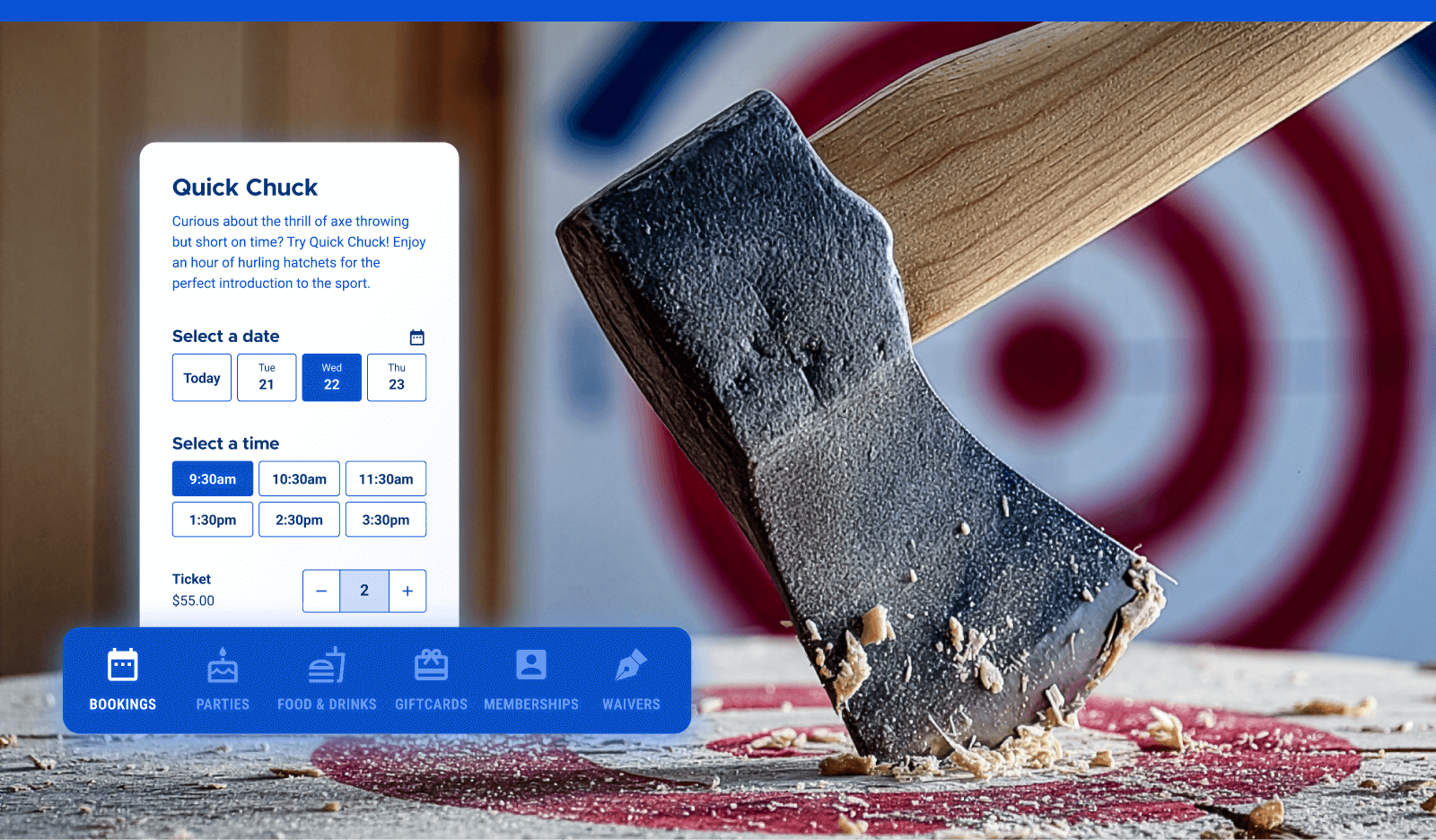
Efficient operations require the right tools. Choosing a management platform early helps you streamline bookings, payments, waivers, and analytics, freeing you to focus on running your business and enhancing the guest experience.
Many operators choose all-in-one venue management software to streamline daily operations and reduce manual work. With axe throwing software you can:
- Manage bookings, POS, digital waivers, memberships, and event scheduling from a single system
- Collect automated guest feedback to monitor satisfaction and identify improvements
- Use analytics dashboards to understand performance, optimize staffing, and make data-driven decisions
- Maintain consistency across multiple locations if you plan to expand
Common challenges to watch out for
Running an axe throwing franchise can be exciting, but it comes with unique challenges that operators need to plan for to keep their venue safe, efficient, and profitable. Here are some of the most common obstacles you may encounter:
- High upfront investment: Opening an axe throwing franchise requires a significant financial commitment, including franchise fees, build-out costs, equipment, and working capital. Having sufficient reserves is essential in case revenue ramps up slower than expected.
- Limited flexibility: Franchises follow strict brand standards for design, programming, pricing, and marketing. This can feel restrictive if you want full creative control over your venue.
- Staffing and turnover: Axe throwing relies on staff who can engage customers, teach safe techniques, and run events smoothly. High turnover is common in hospitality, making ongoing training a constant necessity.
- Safety, maintenance, and compliance: Daily inspections of lanes, axes, and targets, along with strict safety protocols, are critical. Compliance with local regulations and liability requirements is a non-negotiable responsibility.
- Balancing local personality with brand expectations: Customers appreciate venues that feel connected to the community, but local touches must align with franchisor standards. Finding this balance requires creativity and careful planning.
- Dependence on franchisor updates: Franchisees rely on the franchisor for marketing materials, operational improvements, and software updates. Slow or infrequent updates can leave your business at a disadvantage.
- Managing seasonal and demand fluctuations: Business often peaks on weekends, holidays, and during corporate events, while weekdays may be slower. Effective staffing, marketing, and pricing strategies help maintain steady revenue.
- Operational complexity: Running an axe throwing venue involves bookings, events, food and beverage, staff schedules, equipment maintenance, and guest experience. Without proper systems, it’s easy to become overwhelmed.
Setting your venue up for success
Axe throwing is a growing and rewarding industry, but success requires planning, strong operations, and the right tools. Focus on delivering consistent guest experiences, using data to understand your customers, and streamlining processes wherever possible.
Technology plays a supporting role by helping manage bookings, staff, events, and analytics efficiently. While tools alone don’t guarantee success, they make achieving it far more manageable.
If you’re exploring an axe throwing franchise, consider how an all-in-one platform like ROLLER can support your venue. From managing bookings, POS, and digital waivers to tracking analytics across locations, ROLLER helps streamline operations and maintain consistency. Book a demo today to see how ROLLER can help your axe throwing venue run smoothly from day one.
Disclaimer: This article is not intended as legal advice. Venues should coordinate with the appropriate bodies for specific information about regulations and guidelines.
Frequently asked questions about axe throwing franchises
How much does it cost to open an axe throwing franchise?
Costs typically range from $200,000 to $500,000+, including franchise fees, build-out, equipment, insurance, software, and working capital. Exact amounts vary by brand, location, and venue size.
Are axe throwing businesses profitable?
Profitability depends on location, operations, and consistent bookings. Revenue comes from walk-ins, parties, corporate events, and F&B sales. Franchises benefit from proven systems that can accelerate profitability.
What are the benefits of joining an axe throwing franchise?
Franchisees gain a tested business model, brand recognition, training, vendor partnerships, marketing materials, and a support network. These advantages reduce risk and provide guidance, though they limit creative freedom.
What kind of software do axe throwing franchises use?
Most use all-in-one management platforms, like ROLLER, for bookings, POS, digital waivers, events, and customer data. These tools streamline operations, ensure consistency, and provide analytics for informed decisions.
What’s the difference between owning a franchise and an independent axe throwing business?
Franchises offer structure, proven systems, and support but limit creative control. Independent owners have full autonomy but assume all risk and must develop systems from scratch. Both paths can succeed depending on your goals, experience, and desired level of control.
Related articles
Axe-Throwing
Axe Throwing Business Guide: Costs, Profits, and How to Succeed
December 2, 2025
|
7 mins

Guest Experience
Maximizing Customer Experience: Tips for Axe-Throwing Venue Success
January 23, 2024
|
7 mins
.webp)
.jpg)
.jpg)