How to Increase Average Order Value at Your Venue
Key takeaways
- Admission gets guests through the door, but most of your revenue growth comes from what they buy after that: food, upgrades, photos, and extras.
- The biggest gains come from working across the full guest journey, not just at the counter.
- Bundles that feel like a better deal, not a harder sell, consistently drive the highest spend per guest.
You sold out last Saturday. Every session was full, queues at the door, guests spilling into the parking lot. And yet your revenue per visitor was almost identical to a quiet Tuesday in February.
Many operators don’t even notice that gap.
It comes down to everything guests spend beyond admission: food, drinks, upgrades, photo packages, merchandise, premium experiences. Admission gets them in the door. Everything after that is where the real growth sits.
The good news is that increasing what each guest spends is often faster and more practical than trying to drive more traffic. You don't need more visitors, more marketing budget, or more pressure on your capacity. You just need to make it easier for the guests you already have to get more out of their visit.
This guide breaks down how to increase average order value across every stage of the guest journey, from booking through to post-visit follow-up.
Why average order value matters more than attendance
Here's the math. Growing your visitor numbers by 10% usually means more marketing spend, more pressure on capacity, and often more staffing. It's expensive and slow.
Increasing what each guest spends by 10% is a different story. If the right tools are in place, it doesn't require more visitors at all.
Let's make it concrete. Say your venue sees 500 guests a day. If you increase average spend by just $4 per guest, that's an extra $2,000 per day, or roughly $730,000 over a year. Same staff. Same capacity. Same operating costs. The only thing that changed is what each guest chose to spend while they were there.
The metric behind this is simple:
Average order value (AOV) = Total revenue ÷ Number of transactions
Most operators can quote attendance numbers instantly. But ask how their average order value changed month over month, and the answer is usually unclear. That gap is exactly where the opportunity is.
The four stages where guests spend
Most operators think about upselling as something that happens at the counter: a guest is standing there with their card out, and your team suggests an add-on. That's one moment. But it's not the only one.
There are four stages in the guest journey where you can help guests get more out of their visit, and each one works differently.
|
Stage |
Timing |
Example |
|
Pre-visit |
At booking |
"Add a pizza package for 15% off" |
|
Arrival |
At check-in |
Premium session upgrade |
|
In-venue |
During the experience |
Photo package at the exit |
|
Post-visit |
2-3 days after |
"Book your next visit for 10% off" |
The strongest results come from working across all four stages, not just one.
Pre-visit: your online checkout is doing the heavy lifting
The moment a guest confirms their booking is one of the best opportunities to increase average order value. They've already committed, they're excited, and they're still in a buying mindset.
According to ROLLER's 2027 Attractions Industry Benchmark Report, the average online basket is $69.90, compared with just $19.90 at POS, that’s more than 3.5x larger. If your checkout isn’t offering add-ons, bundles, or upgrades at the point of booking, that’s a lot of spend you’re leaving on the table before guests even arrive.
Order bumps: the simplest checkout win
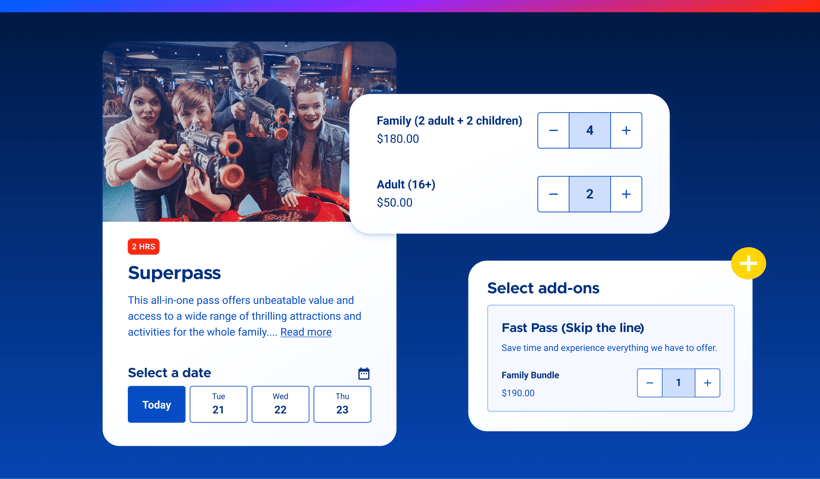
An order bump is a single, low-friction add-on presented at the payment step, usually as a checkbox or one-click option. It doesn't interrupt the flow and doesn't require a separate decision.
Why they work so well:
- The main purchase decision is already made
- The additional cost feels small relative to the total
- It requires almost no extra effort from the guest
The best order bumps are priced under 20% of the booking total, immediately clear without explanation, and directly relevant to the booking. Think grip socks at a trampoline park, a group photo at an escape room, or a drinks combo at a bowling alley.
Sequence your upsells to match the guest's mindset
Placement matters as much as the offer itself. Guests are making different decisions at each step of the booking flow, and structuring your upsells to match that progression is what drives higher conversion.
|
Step |
Guest mindset |
Example |
|
After session selection |
"What kind of experience do I want?" |
VIP access, extra time |
|
Before payment details |
"What do I need for this visit?" |
Food combo, locker rental |
|
During payment |
"I'm ready to pay" |
Grip socks, drinks add-on |
|
Confirmation page |
"What about next time?" |
Membership, next visit discount |
Bundle to make the decision easier
Packaging food with admission, or combining a few add-ons into a single upgrade, simplifies the choice and increases pre-visit spend. Guests get convenience and perceived savings. You get higher order values before anyone walks through the door.
A strong bundle follows a simple structure:
- One anchor item that defines the experience (the session itself or a core food package)
- Two or three complementary add-ons that naturally enhance it (drinks, photos, rentals)
- Pricing that's 15-25% lower than buying items individually
Show the comparison so guests immediately see the value:
$8 pizza + $6 drinks + $10 photo = $24. Bundle price: $19.
Naming matters too. "Birthday Bash" performs better than "Party package: admission + pizza + drinks + 30 min extra." Guests are buying an experience, not a list of line items.
Follow up before the visit
A short, well-timed email between booking and arrival can reintroduce upgrades the guest skipped the first time. Booking confirmation emails tend to have some of the highest open rates you'll see, since guests want to verify their details. That makes them valuable space for a relevant, single add-on offer that feels helpful rather than promotional.
Read more: Maximize Revenue with Smart Upselling
On arrival and in-venue: make the day better
Once guests are on-site, every interaction is a chance to improve their experience and increase what they spend. The best in-venue offers solve small friction points or make the visit more memorable.
Use your POS to surface relevant add-ons
Instead of generic prompts, a connected POS system can suggest extras based on what the guest has already booked. A family checking in for a basic session might see a food package or an extended playtime option. When the suggestion is relevant, it feels helpful rather than pushy.
Get the timing right
Early in the visit, keep it light. Mid-visit is ideal for food and drinks when energy starts to dip. At the end, focus on memory-driven purchases like photos when emotions are at their highest.
Train your team to recommend, not recite
Rigid scripts feel awkward, so they get skipped. The better approach is to train staff to frame add-ons as part of the experience. "A lot of families add the photo package, it's a nice way to remember the day" works better than reading from a list. When it feels natural and guest-first, uptake goes up without anyone feeling pressured.
Make mobile ordering easy to find
According to the 2027 Benchmark Report, the average mobile food and beverage order is $21.30,nearly double the $10.70 spent at the counter. But mobile ordering still accounts for just 6.8% of food and beverage revenue. Put QR codes on tables, mention mobile ordering in your booking confirmations, and ask staff to point guests to it when lines get long.
Consider self-serve kiosks
Kiosk baskets average $54.60, more than 2.7x larger than POS transactions ($19.90). Yet only 1% of bookings currently go through a kiosk. Placing kiosks where lines tend to form (at the entrance or near the cafe) gives guests another way to browse add-ons and buy without waiting.
Lean into what works
Photo packages consistently perform well when the purchase path is simple: clear photo moments during the visit, an easy way to buy, and instant delivery. Other reliable add-ons like lockers, VIP access, and equipment upgrades work for the same reason. They solve a small problem or make the day a little better.
Post-visit: the stage most venues skip entirely
The guest journey doesn't end when someone walks out the door. In fact, the post-visit window is one of the highest-intent moments in the entire experience. Satisfaction is high, memories are fresh, and guests are most open to coming back.
Send photos quickly
A gallery link within 24 hours of the visit, with an easy purchase path and a small time-sensitive incentive, drives quick action while the experience is still top of mind.
Pair review requests with a return offer
Asking for a Google review is great. Pairing it with a small discount on the next visit turns that positive sentiment into a concrete reason to come back, while also building your online reputation. If you're using ROLLER's GX Score, this process can happen automatically.
Introduce memberships at the right moment
Guests are most aware of the value of your venue right after experiencing it. A well-timed email with a membership offer and a sign-up incentive can convert one-time visitors into recurring revenue. This is especially effective for families who are already planning their next visit on the drive home.
Keep referrals simple
Referral programs work well right after a positive experience. A clear mutual reward ("Give your friends 15% off, and you'll get 15% off too") and an easy way to share keeps it low-friction.
How to measure whether it's working
Average order value is the metric that ties everything together. Track it consistently, weekly if possible, monthly at minimum and look for trends.
Break it down by stage: How much of your per-guest revenue comes from pre-visit add-ons versus in-venue spending versus post-visit purchases? This quickly shows you where your strategy is working and where it needs attention.
Review individual add-ons: Check how often guests are adding key extras like food bundles, photo packages, and upgrades. If something isn't converting, it usually points to either how it's positioned or whether it's the right product for your audience. As a rough guide:
- Under 5% uptake: the offer probably needs reworking or removing
- 15-25% uptake: performing well, worth optimizing further
- Over 25% uptake: a strong performer, consider featuring it more prominently or building it into a bundle
Use your reporting tools: With ROLLER's analytics, you can see revenue broken down by product, time slot, booking channel, and more, so you can connect what guests are buying to when and how they're buying it.
Even small gains per visitor add up quickly at scale. A $2 increase across 50 daily guests is $36,500 a year.
Next steps
If you’re looking for a place to start, three things tend to have the biggest impact on average order value:
- Add an order bump at the payment step. It’s the simplest way to give every transaction a low-friction upsell opportunity.
- Introduce at least one bundle that simplifies choices and helps guests feel like they’re getting a complete experience.
- Track AOV weekly so you can see what’s working and adjust what isn’t.
The difference between packed weekends and underwhelming revenue isn't demand. It's how much value guests are getting from their visit.
Book a demo to see how ROLLER helps venues build upsells, bundles, and post-booking offers that work automatically, without adding friction for your team or your guests.
Frequently asked questions about increasing average order value
What is average order value, and how do you calculate it?
Average order value (AOV) is your total revenue divided by the number of transactions. It measures how much each booking or purchase is worth on average. Tracking it weekly or monthly helps you see whether your pricing, bundles, and upsells are actually driving results.
What's a typical average order value for an attraction venue?
It depends on the booking channel and type. According to ROLLER's 2027 Benchmark Report, the average online basket across 1,600+ venues is $69.90, while the average POS (counter) transaction is $19.90. Party bookings average $245.34.
The gap between online and in-venue spending is one of the biggest opportunities most operators have. If you can shift more bookings online or add relevant extras at checkout, average order value tends to follow.
What add-ons convert best at booking checkout?
The add-ons that convert best are simple, relevant, and easy to understand at the point of purchase. Food and beverage packages, grip socks, photo packages, and locker rentals typically perform well because they require minimal explanation and feel like a natural part of the visit.
What is an order bump?
An order bump is a low-cost add-on presented at the payment step, usually as a checkbox or one-click option. It works because the guest has already committed to the booking, which makes it easy to accept a small extra. Order bumps tend to have some of the highest conversion rates of any checkout tactic.
How do bundles increase average order value?
Bundles increase AOV by combining a core experience with a few extras and pricing them below the cost of buying separately. When the savings are clearly shown, most guests see it as a better deal rather than a bigger spend. The guest gets more value, and you get a higher average order.
When is the best time to offer add-ons to guests?
Each stage of the visit works differently. Pre-visit is best for bundles and food packages when excitement is high. During the visit, food and drink offers work well at natural energy dips, and photo packages perform best near the end when emotions peak. Post-visit is ideal for return offers and membership sign-ups while satisfaction is still fresh.
How do post-booking emails increase order value?
Post-booking emails reach guests after they've purchased but before they arrive. By offering a relevant, time-limited add-on during this window, you can capture additional spend without slowing down the original checkout. Confirmation emails tend to have high open rates, making them especially effective.
How does ROLLER help increase average order value?
ROLLER's online checkout lets you configure upsells at each stage of the booking flow, apply rules based on booking type, and track performance across offers. Combined with integrated POS, membership management, and analytics, ROLLER gives you the tools to understand what's driving AOV and continuously improve it.
Related articles

Venue Management
Venue Management Software for Attractions: A Complete Buyer's Guide
July 6, 2026
|
8 mins